
Aseptic Processing Technician Credential (APTC)
Purpose and Value
Sterile manufacturing is one of the fastest growing and in-demand areas of biotechnology and pharmaceutical production, offering strong career opportunities for skilled professionals. The Aseptic Processing Technician Credential (APTC) validates your readiness to work in highly regulated cleanroom environments and contributes to the production of sterile pharmaceuticals biologics, medical devices, and other contamination-sensitive products. Earning this credential helps candidates stand out in a competitive job market and provides a clear signal of industry readiness to prospective employers.
Credential Highlights
- Demonstrates understanding and application of current Good Manufacturing Practices (CGMP)
- Verifies competence in aseptic technique, contamination control, and cleanroom operations
- Confirms proficiency in documentation, regulatory compliance, and sterilization methods
- Signals readiness to work in roles where regulatory rigor and process discipline are critical
If you are looking to transition into, or advance within, regulated life sciences and healthcare industries, the APTC signals employers that you are qualified to meet the rigorous demands of sterile processing environments.
Need Help or Have Questions?
Biotility is available to answer any questions about the APTCE registration process.
Email: biotilitycs@research.ufl.edu
Phone: 386.462.3181 Option #1
Earning Your Credential: The APTC Exam
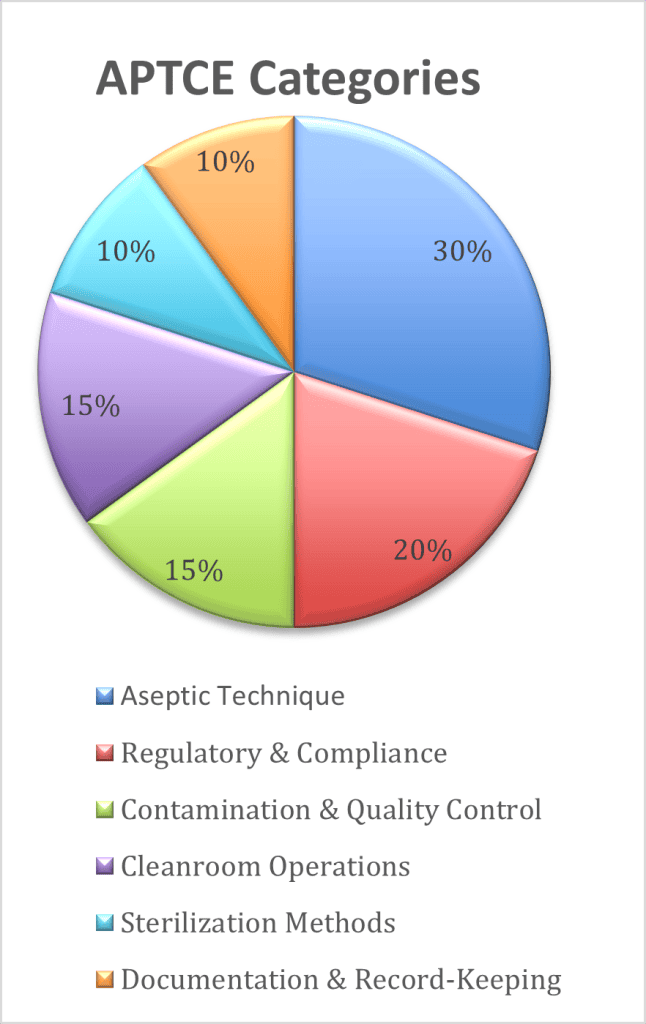
To earn the Aseptic Processing Technician Credential, candidates must take and pass the Aseptic Processing Technician Credentialing Exam (APTCE). The APTCE assesses evaluates a candidate’s readiness to perform aseptic processing tasks in compliance with current Good Manufacturing Practices (CGMP) and regulatory expectations for sterile manufacturing environments. The exam covers six categories including the understanding and application of critical competencies in cleanroom operations, aseptic techniques, contamination control, sterilization methods, documentation, and regulatory compliance.
The APTCE is a closed-book, computer-based exam delivered online through the University of Florida’s e-Learning platform, and proctored remotely via ProctorU. It consists of approximately 75 multiple-choice, scenario-based, and matching questions, administered in a single two-hour session. Candidates must achieve a passing score of 80 percent to be awarded the credential. The credential is valid for five years
Exam Fee: The APTCE costs $215 per attempt.
Credentials are crucial for professionals aiming to advance in the rapidly changing bioscience sector, validating both expertise and proficiency in a specific area.